



November is the month a gutter guard tells the truth about itself.
By now the leaf drop across Berks and Lehigh counties is mostly finished. Whatever a homeowner installed in September has had eight weeks of oak, maple, pine needles and wind to deal with, and the first hard freezes are close behind. Stand in the yard on a rainy morning and look up at the roofline. Either the water is going into the gutter, or it is coming over the front edge.
Homeowners shopping for gutter protection are usually comparing prices. But any useful gutter guard buying guide needs to look beyond price. It’s the easiest number to compare and the least useful one, because the products in that comparison are not doing the same job. Some of them filter debris. One of them sends debris somewhere else entirely. Those two approaches fail in completely different ways, and the difference does not show up on a price tag.
Here are five questions that separate one gutter guard from another. They work on any product, from anything sold in a box to a professionally installed system, and a homeowner can ask all five in about a minute.
1. Where does the debris actually end up?
This is the question everything else hangs on, and most product packaging answers it vaguely.
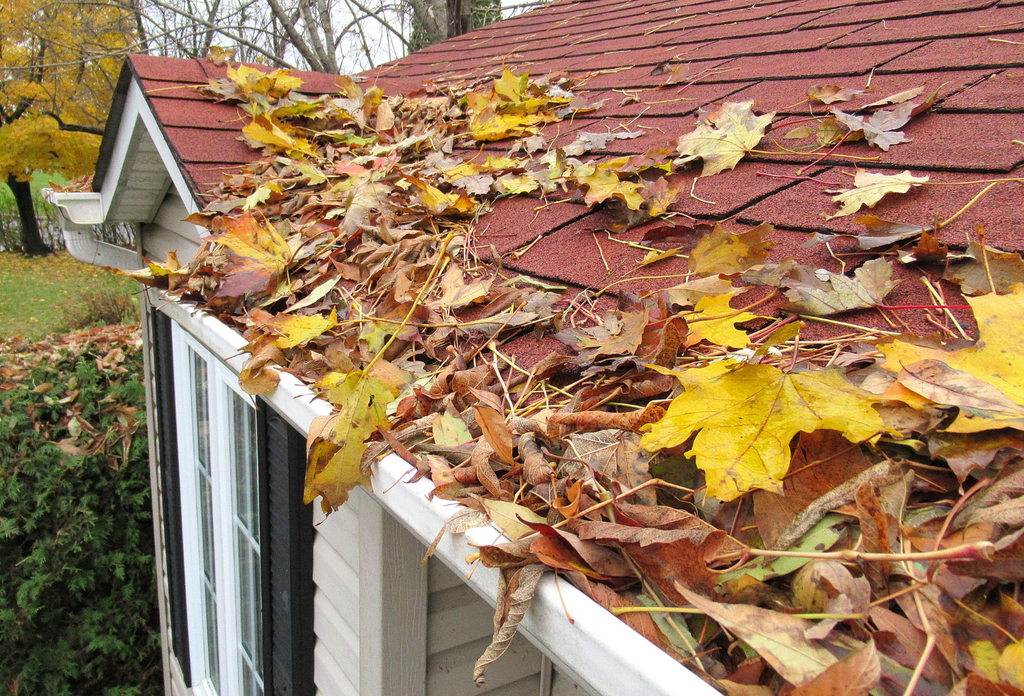
Filter-style protection — screens, mesh, inserts — sits across the top of the gutter with openings small enough to stop leaves and let water through. Debris lands on the guard and stays on the guard. That is not a defect. It is the design working exactly as intended: the product catches things, and the things it catches remain there until weather or a person removes them.
Gutter Helmet takes the other approach. It is a solid cover with no openings at all. Rainwater sheets across the textured surface, clings to the rounded nose-forward edge, and drops through a 3/8″ horizontal slit into the gutter underneath. That is surface tension, the same effect that makes water run down the outside of a glass instead of falling cleanly off the rim. Leaves, pine needles and sticks cannot follow that curve. They slide off the front and land in the yard, which is where they were headed before anyone installed anything.
One product accumulates. The other sheds. Ask which one is in front of you, because everything in the next four questions follows from the answer.
2. What happens to it when it fills?
Anything that catches debris eventually holds debris. The useful question is what the homeowner has to do about it.
On a filter-style guard, fine material is the problem rather than the leaves. Pine needles wedge into openings sideways. Maple seeds and shingle grit slip partway through and stop. Wet leaves break down into a fine mat that dries onto the surface and sheds water like a roof. The gutter underneath can be perfectly clean while rain pours over the front edge and lands at the foundation — which is the exact outcome the guard was bought to prevent.
Clearing that means a ladder. On many products it also means unclipping or lifting sections to reach what got underneath. That is worth knowing before purchase, because it changes what the product is: not the end of gutter maintenance, but the same maintenance done two inches higher with an extra step.
A solid cover has nothing to fill. There is no opening to plug, so water enters the gutter the same way in year fifteen as it did on the day it was installed.
3. How does it attach to the roof?
This question gets skipped, and it is the one with the most expensive wrong answer.
Some guards fasten by sliding under the first course of shingles or by screwing through them. A homeowner can compromise a roofing warranty in an afternoon that way without ever being told it was a risk, and the consequence surfaces years later during a roof claim.
Both the Gutter Helmet product and its installation procedures have been evaluated and approved by major roofing manufacturers, so the roof warranty stays intact. Panels attach with Dacromet-coated fasteners and poly-butyl sealant rather than by disturbing the shingles. Whatever product a homeowner is considering, the question to put to the seller is simple: does this touch my shingles, and has the manufacturer of my roof approved the method?
4. What is the finish rated to survive?
A gutter guard lives outdoors, in full sun, through freeze and thaw, under acidic rain, for as long as the house has gutters. Material matters more here than it does almost anywhere else on a home’s exterior.
Gutter Helmet panels carry the PermaLife coating, a Kynar-based finish that resists UV and acid rain with no perceptible fade for 20 years. The fasteners are coated to the same standard, so the attachment points do not become the weak link. Eight standard colors plus solid copper mean the finished edge reads as part of the roofline rather than as hardware bolted onto it.
For any other product, the question is what the material is and what the manufacturer says it will look like and do after a decade outdoors. If the packaging does not say, that is an answer too.
5. Who is responsible after installation day?
A product bought off a shelf comes with a receipt. A professionally installed system comes with a crew and a paper trail.
Before a single Gutter Helmet panel goes on, the existing gutters are cleaned out, resealed and re-pitched so water actually reaches the downspouts — a step that matters more than most homeowners expect, because a guard installed over a sagging gutter protects a gutter that was never draining properly. Panels are measured and cut to the individual roofline. Most homes are finished in a single visit, and the existing gutters stay where they are.
Behind the installation, Gutter Helmet is backed by a lifetime product warranty from the Gutter Helmet brand, the national product line that Keystone Gutter Helmet installs as an authorized dealer. Whatever a homeowner is considering, it is fair to ask who answers the phone in year seven.

What November adds to the list
Cold changes the stakes on all five answers.
A gutter that drains keeps meltwater moving off the roof instead of holding it at the eaves where it can refreeze. A gutter that is holding a season’s worth of wet debris cannot do that. For rooflines that build ice at the edge anyway, Helmet Heat adds a self-regulating heating cable at the eaves that greatly reduces ice dams, and it is designed to work alongside a Gutter Helmet installation rather than against it.
This is also the month the evidence is easiest to gather. A homeowner who wants to know how their current setup is performing does not need a ladder or an inspection. They need one rainy morning and a look at the front edge of the roof.
See the answers on your own roofline
A free estimate takes one visit. A Keystone Gutter Helmet technician looks at the gutters and the roofline, explains what installation involves on that specific home, and leaves a written quote with no obligation attached.
Request a free estimate or call 610-372-4383. Keystone Gutter Helmet is based in Reading and serves homeowners across Berks, Lehigh, Northampton and Schuylkill counties. To see the mechanism step by step, visit how Gutter Helmet works; for the full picture of what the system protects against, see the benefits and warranty page.